
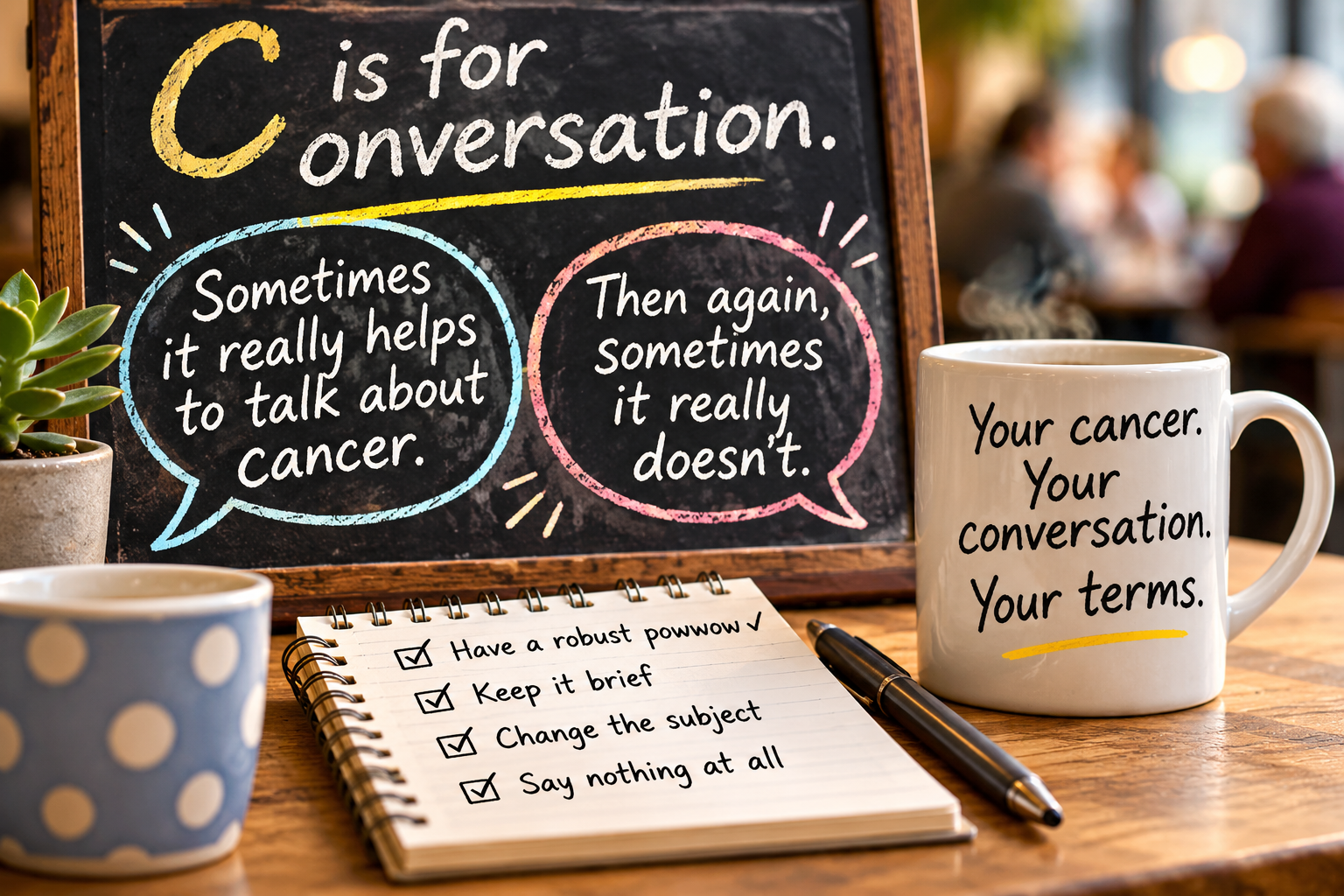
It really helps to talk about cancer. Then again, sometimes it really doesn’t.
There is a widely held belief that talking about our difficulties is an essential part of dealing with them. We are encouraged to open up, share our feelings, articulate our fears and verbalise our experiences. There is considerable value in doing so, but conversation should always be an invitation, never an obligation.
Cancer doesn’t come with a conversational instruction manual.
Go with how you feel and do what is right for you. If you want to have a robust, passionate and unbridled powwow, go for it. If you prefer to say absolutely nothing, no one is authorised to judge you.
You are under no obligation to provide a running commentary on your experiences, explain your emotions or make your private struggles publicly available.
Some days, conversation can be cathartic. Other days, silence can be restorative. You might even want to talk about absolutely everything except cancer.
You are entitled to change your mind, change the subject or close the conversation altogether.
Your cancer. Your conversation. Your terms.
No one is authorised to judge you.
Conversational sovereignty
I believe cancer patients should have what I call conversational sovereignty. This is the freedom to determine when, where, how, with whom and to what extent we discuss our illness.
Being diagnosed with cancer does not mean surrendering ownership of your personal narrative. You are under no obligation to provide a running commentary on your treatment, your prognosis, your emotional state or your innermost thoughts.
Being an open book doesn’t mean every chapter is available for public reading.
There may be days when you want to discuss cancer in forensic detail. You might want to dissect every aspect of your diagnosis, explore every conceivable outcome and give your emotions an unrestricted airing.
On other days, you might want to talk about the weather, football, gardening, music or the price of a loaf of bread.
Sometimes the conversation you need most is one in which cancer doesn’t get a mention.
Conversation can be exhausting
What isn’t always appreciated is how tiring it can be to talk about cancer.
There is an emotional expenditure involved in repeatedly explaining what has happened, what is happening and what might happen next. Retelling your story can mean revisiting experiences you would rather not revisit.
For some patients, particularly those with head and neck cancer, conversation can also be physically demanding. Speaking may require considerable effort, and the energy available for social interaction may be limited.
Sometimes, we simply haven’t got the conversational bandwidth. I personally find it extremely difficult to speak and join in conversations because my spontaneous ability has been taken away. I have no tongue but I still get tongue tied.
By the time I have managed to articulate what I want to say, the conversation may have moved on. The moment for a witty remark, an observation or a contribution has often passed. The natural rhythm of conversation, with its interruptions, quick exchanges, banter and spontaneous humour, is something I can no longer participate in as freely as I once did.
But let’s imagine that you can speak freely. Even the well-intentioned question, ‘How are you?’ can be surprisingly complicated. Do you give the abbreviated version, the medically detailed version, the emotionally honest version or the socially convenient version?
Sometimes, ‘I’m doing okay, thanks’ is all you want to offer, and that should be enough.
Silence is not necessarily suppression
We need to resist the temptation to interpret silence as evidence that someone isn’t coping.
Not everyone processes adversity verbally. Some people find clarity through writing, walking, music, creativity, solitude or simply getting on with the business of living.
Silence can be a conscious and constructive choice. It can provide respite from the relentless medicalisation of everyday life.
Equally, there is no shame in discovering that you need to talk. Seeking support from a friend, family member, counsellor or fellow patient can be enormously helpful.
The important thing is that the choice belongs to you.
You can be a conversational extrovert on Monday and a conversational introvert on Tuesday. You don’t have to adopt a consistent communication policy just because you have a consistent diagnosis.
Be a person, not a talking diagnosis
Cancer can occupy an extraordinary amount of our time. There are appointments, scans, treatments, medications, procedures and consultations. Much of our vocabulary becomes medical.
Sometimes, what we crave most is a thoroughly non-medical conversation.
We want to laugh at something ridiculous, exchange opinions, indulge in some harmless nonsense and participate in the wonderfully ordinary chatter of everyday life.
We want to be interesting for reasons other than our medical histories.
For those supporting someone with cancer, remember that being a good conversational companion isn’t necessarily about asking the right questions. Sometimes it’s about recognising when no questions are needed.
Offer an opportunity to talk, but don’t impose an expectation to talk. Be available without being intrusive. Allow the conversation to meander into territory where cancer has no jurisdiction.
Your cancer, your conversation, your terms
Some days, conversation is cathartic. Other days, silence is restorative.
You are entitled to speak passionately, cry openly, laugh outrageously, change the subject abruptly or say nothing whatsoever.
Cancer may have acquired a considerable presence in your life, but it hasn’t acquired exclusive broadcasting rights.
Talk when talking helps. Seek support when you need it. Enjoy silence when silence serves you. And never feel obliged to justify your conversational preferences to an audience.
Freedom of speech also includes freedom from the expectation to speak. Your cancer. Your conversation. Your terms.
Enjoyed reading this? Please consider donating to my GoFundMe and help support me through my own cancer journey: https://gofund.me/2a6d5199