
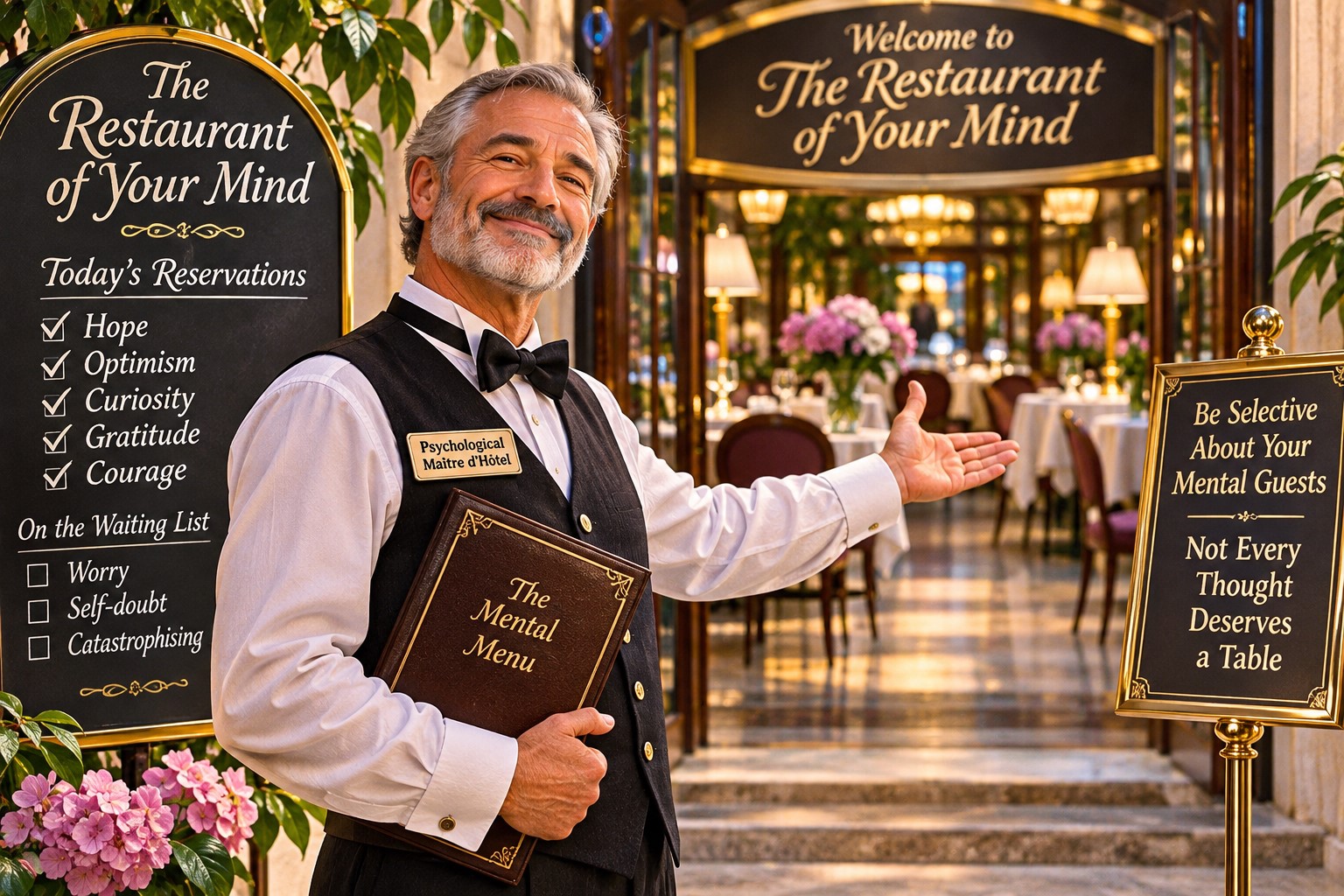
Your mind is open for business. Who’s getting the best table?
Imagine being the maître d’hôtel of the most exclusive restaurant in the world: your own mind.
You’re in charge of the reservations, the seating arrangements, the atmosphere and, most importantly, the quality of the experience. You decide which thoughts deserve your attention, which attitudes receive preferential treatment and which uninvited guests need politely managing.
Welcome to the world of the psychological maître d’hôtel. You are master of your house.
No expensive membership fees. No waiting lists. No dress code. Just exclusive access to the extraordinary establishment between your ears.
And the best part? You’re both the maître d’hôtel and the most important guest.
Mind your reservations
Every day, hundreds of thoughts come knocking at your mental restaurant. Some arrive with impeccable manners, bringing optimism, hope, curiosity, gratitude and courage.
Others are considerably less agreeable.
Self-doubt arrives without a reservation, demands the best table and immediately starts complaining. Pessimism insists everything on the menu will be disappointing. Anxiety wants to know what could possibly go wrong before the starters have even arrived.
And your inner critic? It’s already writing a scathing one-star review.
Here’s the thing: just because a thought turns up doesn’t mean you have to give it the best table in the house.
You cannot always control which thoughts arrive, but you can learn to manage how much attention and influence they receive.
Give hope a standing reservation. Make optimism a regular. Let gratitude become one of your most valued guests.
And remember, not every thought deserves an extended sitting.
Create the right atmosphere
Every excellent restaurant understands the importance of ambience.
The lighting, music, surroundings and service all influence how people feel.
Your mind operates in much the same way.
The thoughts you repeatedly entertain help create your psychological atmosphere. Constant criticism, catastrophising and comparison can make your mental restaurant feel distinctly unwelcoming.
Encouragement, curiosity, humour and self-compassion can create a very different environment.
This doesn’t mean pretending everything is wonderful. A psychological maître d’hôtel isn’t employed to manufacture artificial happiness or deny uncomfortable realities.
Sometimes sadness needs a quiet corner. Fear deserves to be heard. Disappointment may need time at the table.
The secret isn’t to banish every difficult emotion. It’s to ensure no single emotion takes over the entire restaurant.
Be selective about the menu
What are you serving yourself today?
A generous helping of possibility? A side order of courage? Perhaps some freshly prepared perspective?
Or are you repeatedly dishing up yesterday’s regrets, reheated resentment and an oversized portion of worry?
Your mental menu matters.
The stories you tell yourself influence how you interpret experiences, approach challenges and respond to setbacks.
Try making optimism your house speciality, with realism as an essential ingredient.
Serve hope generously, but don’t confuse it with guaranteed outcomes.
And remember that a balanced psychological diet includes room for uncertainty, vulnerability and occasional disappointment.
You don’t have to swallow every thought your mind serves up.
Manage your inner critic
Every restaurant encounters difficult customers. Your inner critic can be one of the most demanding.
It notices every imperfection, questions your decisions and insists that whatever you’ve achieved simply isn’t good enough.
But criticism isn’t always constructive, and self-criticism isn’t automatically self-improvement.
As maître d’hôtel, you can acknowledge a complaint without accepting every accusation.
Ask whether the criticism is useful, fair or proportionate.
If there’s something worth learning, take it on board. If it’s merely another helping of unnecessary self-reproach, politely decline.
Your inner critic can have a voice, but it doesn’t deserve a permanent seat at the head of the table.
Remember the importance of good service
Here’s an interesting question: how would you treat someone visiting your restaurant?
Would you belittle them, dismiss their concerns or constantly remind them of their shortcomings?
Of course not.
You’d offer courtesy, patience, understanding and encouragement.
So why should the service you provide yourself be any different?
Being your own psychological maître d’hôtel means extending the same hospitality inward that you willingly offer others.
It means recognising when you’re exhausted, when you need encouragement and when asking for help is the most sensible item on the menu.
Even the finest establishments occasionally need outside expertise.
Your table is ready
You won’t always run a flawless mental restaurant.
Some days the kitchen will be chaotic, the reservations will be muddled and your emotional waiting staff will be rushed off their feet.
That’s life.
The aim isn’t psychological perfection. It’s becoming more intentional about the thoughts you entertain, the attitudes you cultivate and the kindness you extend to yourself.
So take your place at the entrance to your mind.
Welcome curiosity. Give courage a prominent table. Keep a reservation for hope. Allow difficult emotions their rightful place without letting them dictate the entire evening.
And above all, remember that you’re not merely managing the establishment. You’re also living in it.
Be your own psychological maître d’hôtel. Make your mind a place where possibility always has a seat at the table.
Reservations: Open 24/7. Hope: Always welcome. Self-compassion: On the house.
Enjoyed reading this? Please consider donating to my GoFundMe and help support me through my own cancer journey: https://gofund.me/2a6d5199