
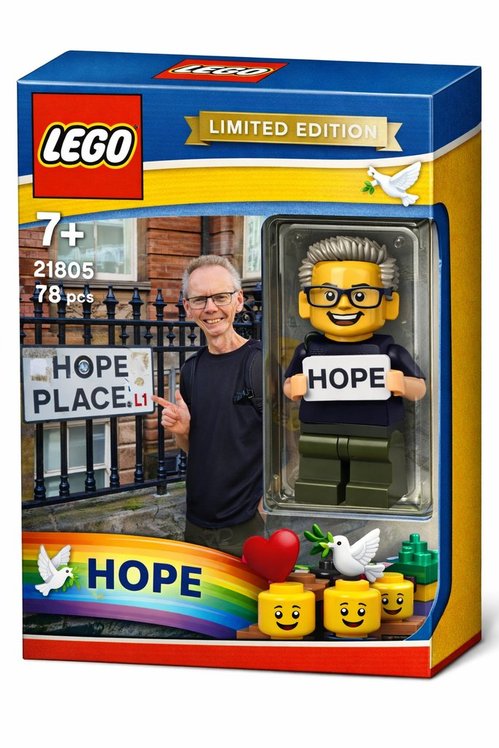
We often talk about hope as if it’s something that turns up on its own like sunshine breaking through clouds or a sudden feeling that everything will be alright. We wait for it. We look for signs of it. We assume that one day we’ll wake up and simply feel hopeful again.
But life has a way of teaching a different lesson.
Hope doesn’t arrive built.
You assemble it.
And most days, you assemble it with very small pieces.
Hope doesn’t just depend on your mood, optimism, or personality. Anyone who has walked through illness, uncertainty, loss, or disruption knows the truth: hope is an action.
It begins with doing the next thing.
Getting out of bed when motivation hasn’t shown up. Taking the walk. Making the call. Completing one manageable task when the bigger picture feels overwhelming. None of these moments look heroic. They barely register as progress.
But they are bricks.
Each small act clicks into place, quietly forming structure where chaos once lived.
When life changes for the worst we assume the build has failed. We compare the unfinished version in front of us with the original plan we thought we were following. That comparison can feel discouraging. Sometimes even unfair.
Yet rebuilding is not failure. It is adaptation.
Children understand this instinctively when they play with building blocks. If something collapses, they don’t sit staring at the pieces wishing the tower would rebuild itself. They start again. Maybe differently. Maybe smaller. Maybe stronger.
Somewhere along the way, adults forget this permission.
Hope grows not from certainty but from participation. You don’t need to know how everything will work out. You only need the next piece.
One step creates momentum.
Momentum creates belief.
Belief strengthens endurance.
Before long, you look back and realise something important: the structure exists not because hope appeared, but because you kept assembling it, even on days when you doubted it was working.
This is why hope is practical.
Hope lives in routines more than revelations. It hides inside repetition. It strengthens through consistency rather than grand gestures.
You assemble hope when you:
- choose action over paralysis
- accept reality without surrendering possibility
- allow progress to be imperfect
- and keep clicking pieces together despite uncertainty
Some days the pieces feel tiny – a conversation, a smile, a completed appointment, a moment of laughter that arrives unexpectedly. Yet small pieces hold surprising strength when connected.
A single brick cannot support much weight.
A structure made from many bricks can carry extraordinary loads.
Hope works the same way.
It is not fragile because it is modular. If one part breaks, you rebuild from what remains. Nothing learned is wasted. Every previous piece still counts.
And perhaps the most powerful part of assembling hope is this: others begin building alongside you. Your steadiness becomes permission. Your persistence becomes instruction. Without meaning to, you hand someone else their first brick.
Hope spreads through example more than explanation.
So if today feels unfinished, uncertain, or far from the design you once imagined, remember this:
You are not waiting for hope to arrive.
You are already building it.
Piece by piece.
Choice by choice.
Day by day.
Because hope was never meant to be delivered complete. It was always meant to be assembled.
Enjoyed reading this?
Please consider donating to my GoFundMe and help support me through my cancer journey: https://gofund.me/2a6d5199